David Brooks has been linked to a move to Man United after a rocky year at Bournemouth. With the south-coast side being relegated this season, Brooks will be hot property as one of the most talented players in the side who will surely want to stay in the Premier League. However, Brooks himself has had a tough time, being injured for most of the 19/20 season and only playing after the Covid-19 break. Despite this, though, his direct running and forward approach would be ideal for a top-half team in the future, and he has a bright future as a still young player.
If Brooks was to move to United, he would have to fight for a place with the likes of Martial, Rashford and Greenwood as a front three. His main opposition would instead be with the rotation attackers: Daniel James, Andreas Pereira, Juan Mata and Jesse Lingard. Brooks is comfortable in both the right-wing position and 10 position – similar to Pereira, Mata and Lingard. James is the only out-and-out winger there, while the other three have played both positions. According to WhoScored, Dan James started the most games on the right wing this season at thirteen, with Greenwood at ten, Pereira at five, Mata at three and Lingard with one. Moreover, Greenwood has played brilliantly on the right-hand side, and should be expected to start there next season, and subsequently isn’t for contention here. Bruno Fernandes, who came into Manchester United in January, has nailed on his role at the 10 role, and while Brooks can play there, the AM position should also not be in the discussion. It is also worth remembering that Brooks is still young at 23, vs James (22), Pereira (24), Mata (32) and Lingard (27).
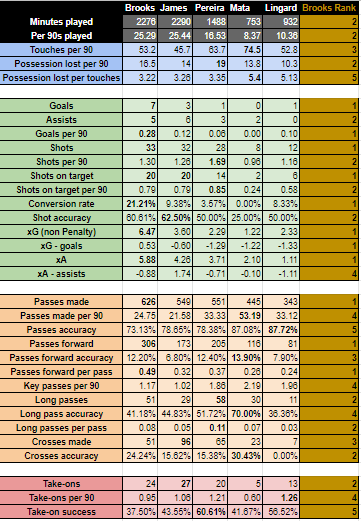
Using Brooks 18/19 stats, which should be his expected return after playing 30 top flight games, I will compare him to his Man United competition (with their 19/20 stats). I will be using Squawka, WhoScored and Understat for my stats.
Touches per 90
Compared to Man United players, Brooks takes the third fewest touches of the five, with 53.2 per ninety, behind Mata and Pereira. The latter two play more centrally in the midfield, with Mata especially (74.5 touches per ninety) looking to get onto the ball, and Pereira not far behind at 63.7 t/p90. Bournemouth’s attacking style has shifted in the last few seasons into a more fluid approach, sometimes looking to play on the break, but despite this Brooks’ 53.2 is impressive, showing he is a key figure for Bournemouth when he floats inside, and can be for other teams. His Welsh counterpart, Daniel James, is a more out-and-out winger, and shows that with the fewest touches per ninety of the group (45.7), while Lingard rounds out the group with 52.8, a number close to Brooks’ own, despite playing less than half of his minutes.
However, despite his willingness to get on the ball, he does not conserve it as well as the others. He loses the ball the second most times per ninety (16.5, vs James’ 14; Pereira’s 19; Mata’s 13.8 and Lingard’s 10.3), and he also has the least touches per possessions lost, losing the ball once every 3.22 touches, compared to 3.26, 3.35, 5.4 and 5.13 of the others in the same order. This might be due to Bournemouth’s own troubles in attacking though, but there is a clear gap against Mata and Lingard that need to be addressed. However, ball retention is not a very useful stat in isolation, as it might be due to aggressive and creative play that is preferred to a conservative approach.
Goals and shots
David Brooks was one of Bournemouth’s most lethal attacking forces in the 18/19 season, and it shows in comparison to the group. He made seven goals and five assists in the 18/19 season, better than all the others besides James’ six assists this season. He actually overscored his xG, according to understat.com, which valued it at 6.47 for the six goals he scored, although it was far higher than the others regardless. The four United players underperformed their xG score – Dan James scored three from an xG of 3.6; Pereira had one from xG of 2.29; Mata didn’t score any goals from his 1.22 xG; and Lingard grabbed one from his 2.33 xG. However, his xA (expected assists) was slightly underperformed in the season, making five goals from an xA of 5.88, with his largest competition Daniel James overperforming at 4.26 xA to his six assists. Pereira also underperformed with three assists to an xA of 3.71; Mata largely hit his xA with 2.1 to two assists; and Lingard largely underperformed with no assists from an xA of 1.11.
Brooks shows to be a more attacking-minded forward than his counterparts, with the most shots of their respective seasons (30), and the second most shots per ninety (1.3, behind Pereira’s 1.69). Moreover, he boasts the most shots on target and the second most per ninety (tied with James at 20 and 0.79 per ninety), again behind Pereira’s per ninety at 0.85 shots on target. However, Brooks’ conversion rate is far higher than the others, at 21.21% with James the closest in second at 9.38%. His overall shot accuracy, too, is second at 60.61%, again lagging James’ 62.5%. This could indicate a certain degree of luck for Brooks, although he is great at finding pockets of space unmarked and getting a good finish off as well. David Brooks is clearly an aggressive forward who can pick an accurate shot out, and might be a better choice for United if they want a strong attacking back-up on the right wing.
Passing, crossing and take-ons
Although Brooks made more passes than his opponents here in their respective seasons, he is only fourth for passes made per ninety. This, coupled with his pass accuracy of 73.13% being the lowest in the group, suggests that he is wasteful in possession when not gifted with an opportunity to shoot. Lingard and Mata – the two more comfortable tens – have the greatest pass accuracy of 87.72% and 87.08% respectively (with Mata himself making the most passes per ninety – 53.19), while James and Pereira are at 78.65% and 78.38% respectively. This may not be a great concern since his numbers are most similar to Daniel James’, his most direct comparison at right wing, while also being a testament to his Bournemouth teammates not being as able to receive the ball to United’s own – so it should not be too much of a concern.
Furthermore, Brooks makes the most passes forward, outright (306), and most forward passes per pass made (0.49 of all passes). Almost every other one of Brooks’ passes go forward, perhaps indicating his lower pass accuracy and possession loss stats. Despite this, though, he only makes the fourth-most key passes per ninety, only producing 1.17 a game, behind better passers like Pereira’s 1.86, Lingard’s 1.96 and Mata’s 2.19. The Bournemouth player also makes a large amount of long passes compared to three of the United players, with fifty-one made (and 0.08 long passes per pass), only behind Pereira’s 58 long passes (and 0.11 long passes per pass). However, Brooks’ long pass accuracy leaves some to be desired, only the fourth-highest at 41.18%. Unsurprisingly, wizard-on-the-ball Juan Mata has the highest completion rate of 70%, from thirty long passes. Brooks’ crossing is slightly stronger, making the third-most but with the second highest crossing accuracy (51 and 24.24%), behind James and Mata respectively. However, this might be due to the style of his opponents here, with James the only out-and-out winger, and despite making by far the most crosses, having a lower 15.62% accuracy. Only Mata has a higher crossing accuracy, at 30%, although he made less than half as many. It is clear that when it comes to passing, and especially longer-ranged passing, the other United players are better than David Brooks has been so far.
In terms of dribbling, Brooks is not much of a one-on-one player. He made the second most take-ons (24), but comes fourth for take-ons per ninety (0.95) and last for take-on success rates (37.5%), displaying another avenue of play where he loses the ball often, and the likes of Pereira and Lingard, with higher rates of 60.61% and 56.52% respectively, might be preferred. Furthermore, Daniel James makes the most take-ons (27) with a higher per ninety stat (1.6), with a greater success rate (43.55%) to show that there are better options at the club.
Conclusions
Brooks has a nature of taking the ball in a relatively deep-playing Bournemouth side, pressing forward and drifting inside with the overlapping right-back making a run, and off-loading the ball in a pass forward to get in position for a shot, should it come back to him. His shooting stats are impressive, with per ninety shooting and accuracy metrics consistently in the top two of the group, and with an impressive seven goals and five assists in the 18/19 season showcasing this. His game suffers in passing metrics, where he shows a relatively low passing and long-passing accuracy, although his forward passes and long passes show that he is an aggressive and attacking player, which may be more successful in a higher quality side.
Furthermore, Brooks is still a young player at twenty-three, with his biggest opposition for game-time being Daniel James a year younger. Brooks here has a better output than Lingard, and although Mata’s passing stats are better, his age is getting to him and he will be moved on soon. Brooks would probably be a good addition if Ole Gunnar Solskjaer wanted him in the side, offering a different but equally quality option to Daniel James, with the two Welshmen potentially being in the side for years to come.

 One Geo Under A Groove