“While religion is no basis for ethics, neither is nihilism, which would suggest a worldview of lawlessness and “fuck around and find out””
Princess Mononoke is my favourite Studio Ghibli film. I’m not sure it’s the best one – it battles for that title with the likes of Howl’s Moving Castle, Kiki’s Delivery Service and Spirited Away – but it’s the one that I connect to most strongly. Many of the Studio Ghibli films share a lot of similarities, with chief director and writer Hayao Miyazaki often including strong female leads, a grey-morality villain rather than outright-evil, and strong themes that touch upon anti-war or peaceful resolutions. It does these things well, with leading women in Sophie from Howl’s Moving Castle, Chihiro/Sen in Spirited Away, the eponymous Kiki with her delivery service, Fio in Porco Rosso, and Satsuki in My Neighbour Totoro, to name a few. Similarly, the villains range from desperate antagonists to practically nonexistent. Kiki’s Delivery Service and My Neighbour Totoro (spoilers) don’t really have villains, with the third-act crisis being depression and illness respectively. Princess Mononoke does share these traits too – San is a strong lead beside Ashitaka, and the villain Lady Eboshi is not totally evil.
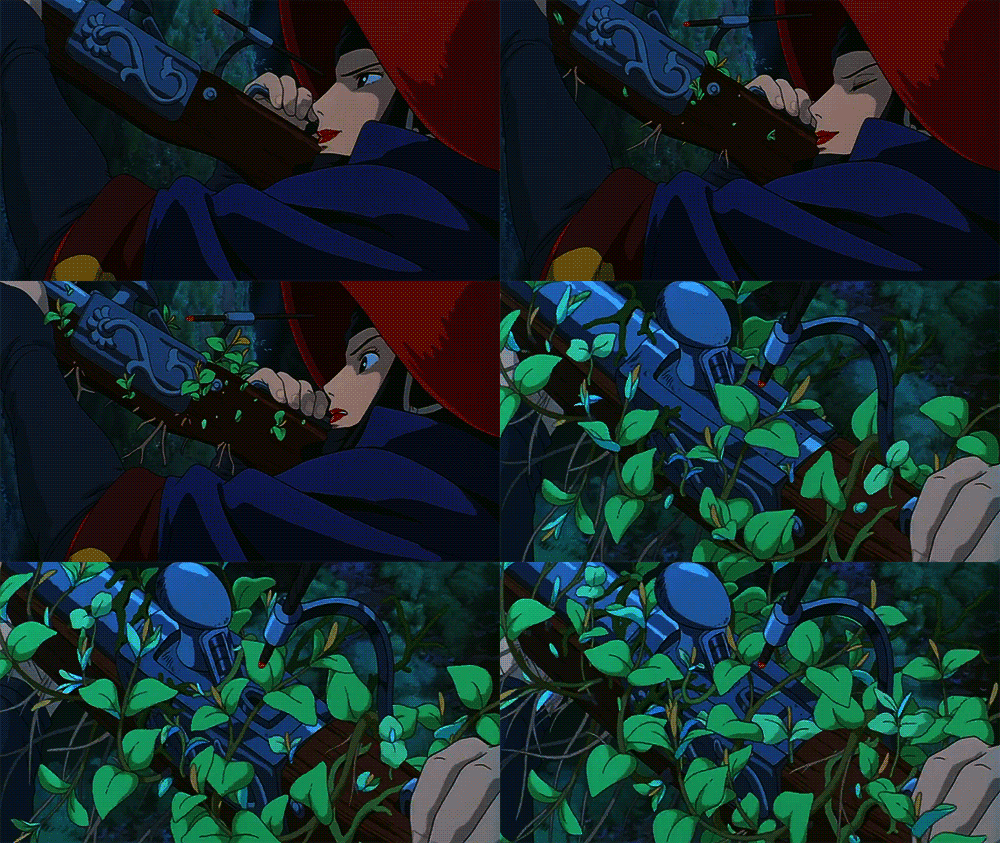
However, thematically, Princess Mononoke is darker than other Studio Ghibli release, rivalled (but not topped, in my opinion) by only one other film, Castle in the Sky. The film centres itself in an industrialising Japan that is fighting over the balance of nature versus industry, tradition versus progress, and very much for the viewers it is peace and healing versus greed and conflict. I think it’s worth noting that, although they don’t explore it in the same way, other Ghibli films made in the same time period also focused on ideas like this too. Between 1997 and 2004 there were three films released that were written and directed by Hiyao Miyazaki: Princess Mononoke, Spirited Away and Howl’s Moving Castle, and they all entertain anti-western themes among them (although this was also coming through in 1992’s Porco Rosso, where the antagonist is a very annoying American who wants to be a future President called Donald Curtis…). The first, Princess Mononoke, shows us a war between the natural world and the industrial one, and the chaos that reigns when it is thrown out of balance and the Forest Spirited is murdered and decapitated to fulfill the Emperor’s greed for immortality. Spirited Away presents us with anti-consumerist themes, starting from Chihiro’s parents being turned into pigs for eating food that wasn’t theirs; to the river spirit that had turned into a disgusting mess because its essence had been plugged by a bicycle that had been thrown into its river; and to No-Face, the mysterious and misunderstood spirit, who tries to make friends by giving away mountains of gold, which the bathhouse workers are all too keen to snap up. Finally, Howl’s Moving Castle is perhaps the strongest example, where the ominous spirits hunting Howl down are made of an black oil consistency, the eponymous character is out fighting both sides of a war he refuses to be drafted in in a self-destructive attempt to stop the conflict and, when at the end we find one final twist in the plot, peace is brokered when they finally realise what a frivolous reason to fight it was. Howl’s Moving Castle is littered with juxtaposition of peace and bombs, kindness and gunshots, every-day living and soldiers, and it is no coincidence – it was made as America went to war in the Middle East, capping off five years of filmmaking that tried to push against all the West represented. I could write about any one of these films, and perhaps in the future I will some more.
Despite the conflict that Howl and Sophie face, it is still eclipsed by the violence in Princess Mononoke. The film starts with a battle, as the hero Ashitaka protects his home town from a boar that has been turned into a demon, pulsing with disgusting worm-like toxic tendrils. It is during this that Ashitaka is struck on his right arm and cursed, with the elders telling him he does not have long to live. And he is faced with a choice: does he go looking for a cure, knowing that if he leaves his home, he can never return?

Now I’m sorry, but I need to force upon you another tangent. Because this post is not only about a film or a hero – it is about philosophy, and what we can perhaps learn from that film or hero. In particular: nihilism (and in particular, Friedrich Nietzsche’s views on it). Nihilism is sometimes mischaracterized as just misanthropy, which is the dislike of generally all people (see House, MD. as an example). Misanthropes might be nihilists, but they are not the same thing. Nietzsche began to think on nihilism as a response to his one true hate, which was religion and Christianity. The foundation to these is the idea that what you do while you’re alive on Earth matters, because you will be rewarded in heaven (or condemned to hell). However, he was an atheist and didn’t believe in religion, God, or an afterlife, so he rejected this view, suggesting there was “tension […] between what we want to value (or need) and how the world appears to operate”. He went further, understanding that those who believe in an afterlife will put themselves through suffering if they believe that will take them to heaven – and therefore, giving the idea that, in religion, there is meaning in suffering. He instead suggested nihilism as the alternative to religion, which tells us the opposite: there is no meaning in suffering, which itself lends itself to the mindset of depression and incels who believe that life is supposed to be meaningless and filled with suffering. This is where we typically get the idea that nihilism is about apathy and misanthropy, which is not necessarily the case. This is also where one of Nietzsche’s best known quotes comes from, “God is dead, and we killed him”, because Nietzsche believed that Christianity was not a strong enough value system for people to judge themselves by.
However, nihilism isn’t the end of that tricky philosophical road. As suggested, while religion is no basis for ethics, neither is nihilism, which would suggest a worldview of lawlessness and “fuck around and find out”. Nietzsche suggested a third option, which can be called “active nihilism”, but I am going to call “anti-nihilism”. Anti-nihilism is the idea that if you no longer follow religion’s doctrine of ethics and values, you can make your own. Rather than collapse in on yourself in a meaningless world, you can do what you think is right and live by your own values. Before I get back to the film, it is worth mentioning that what Nietzsche wrote about “active-nihilism” was sort of misinterpreted by the Nazis into their creed of fascism, which is not good. He wrote about the journey of a “free spirit”, someone who sets their own values and practices active-nihilism in a way that he likens to an artist, who then becomes an ubermensch. The iconography of an ubermensch entered Nazi ideology thanks to Friedrich Neitzsche’s sister after he had died, where it was manipulated to invoke Aryan supremacy.
Ahhh, I’m glad we got the Nazis out of the way so we can focus on the film now.
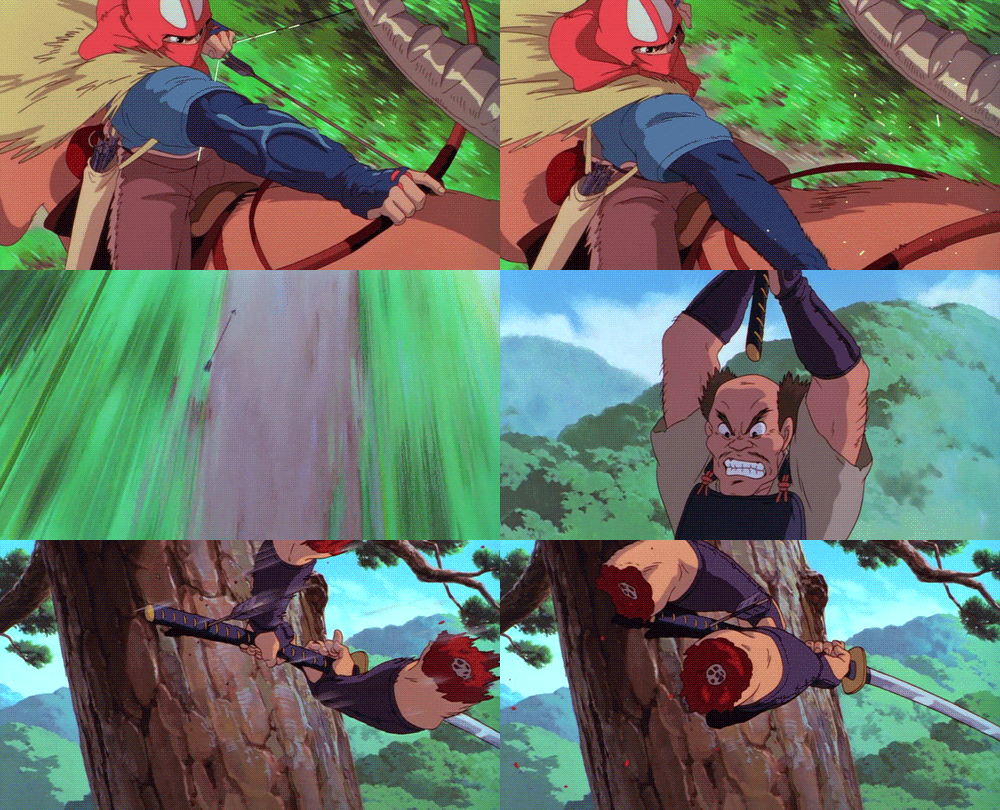
We left our story, Princess Mononoke, at the end of the first act. It is the typical Point Of No Return in a story, where our character has to step over the threshold and embark on their journey. But Ashitaka is different, because he has been cursed. While he lived in his traditional village, he could believe in spirituality and religion as his ethical system. That was shattered for him the moment he had to cut off his ceremonial top-knot and leave in the middle of the night, no longer protected or bound to the system he once believed in. He leaves his village as a nihilist, where for saving his town, he was cursed, not rewarded, and he will surely die if he does not find help from somewhere. And his cursed arm reflects this too, as it takes a mind of its own. It bulges with strength, uncontrollable for Ashitaka its host, and is so chaotic and strong that, early in the film, he takes off both arms from a man’s body with a single arrow shot. He is a stranger to this new world, no longer sheltered and protected.
But, he doesn’t stay that way. Knowing he will soon die, he decides to help people. After a bloody battle the night before, he finds an injured stranger in the river, and decides to take him home so that he can get help. They go through the sacred forest, where Ashitaka is told he can cure his arm, but he does not stop until they get to their destination, Iron Town. Throughout the film, Ashitaka continues to do good things for people: he helps the women in the iron forge, he protects San, the girl who attacks Iron Town, and he looks out for San and Lady Eboshi both through the conflict. And, when he is nearing exhaustion and death, he is rewarded. The film starts with Ashitaka sacrificing himself to defend his town by killing the demon, and he continues doing good, selfless things until the end. He does not ask for anything, he doesn’t really act like he deserves anything either. He does good things for the sake of doing good things, and he is rewarded when his curse is lifted.
Ashitaka represents anti-nihilism in the way that he is faced with the worst of life’s hardships, and he does not break or falter. He is surrounded by characters who are influenced by greed and revenge, and he could very well follow down that road of nihilism too. But he doesn’t. He forges his own path of respect and kindness, and against the odds he is rewarded for it.


 One Geo Under A Groove