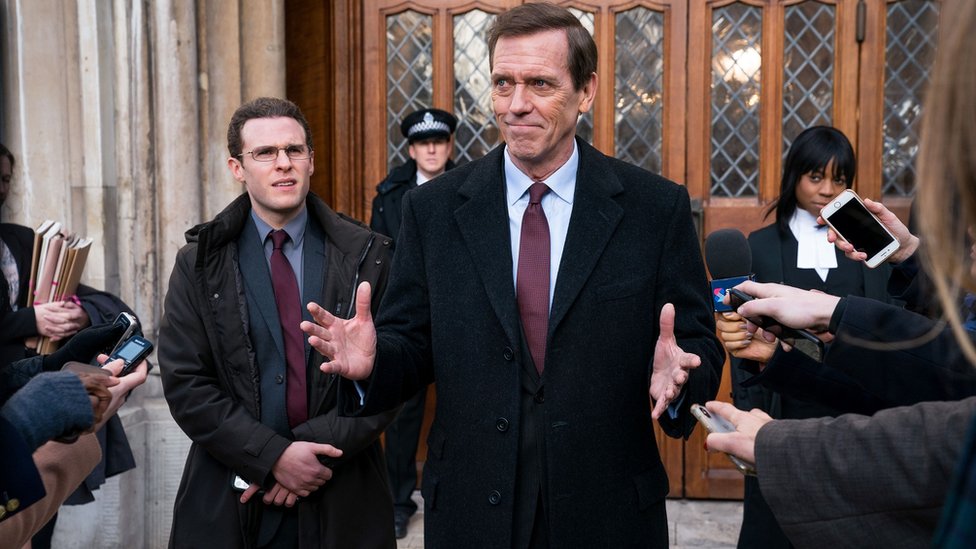
Looking back on the four-episode programme, Roadkill aspires to reward patience, and clever and careful politik. Unfortunately, it instead leaves an aftertaste of a show that pulled victories, defeats, vendettas and heroes from thin air. Spoilers ahead.
The programme starts with a victorious Peter Lawrence, played by Hugh Laurie, leaving court victorious. We’re told who he is very quickly – a rebel, a rulebreaker, and a winner. He takes a chance to fight a libel case, and wins. But after that, and it becomes clear that the public love him far more than his own aides and political peers do. He regularly takes selfies in the street with fans and hosts his own radio talk show, but seeminging everyone around him is quietly plotting his downfall.
His special advisor Duncan, played by Iain De Caestecker, at first seems to be doing the best for him, but is rather literally sleeping with the enemy – the Prime Minister’s own Personal Aide. He is shocked when he finds out that she has been leaking information about Lawrence to the PM, which means that he is either really stupid or really naive, and neither fits his character or the story. His personal driver, Sydney, initially keeps his secrets, but it turns out hates him and is leaking information about him to her girlfriend, who turns into a fairly inconsequential and annoying witness to his previous court case. He has one named aide in his department who is loyal to him, and she barely has a role in the entire story.
And then you get to the Prime Minister herself (Helen McCrory), who is both plotting Lawrence’s downfall, while also giving him a promotion in a cabinet reshuffle instead of just sacking him or keeping him as the Minister for Transport. She presumably fears that he will become a disloyal backbencher if he is gone, but she also gives him what is seen as a trainwreck of a job (Minister for Justice), hoping it destroys him and, what, makes him disloyal to her? What did she expect to happen when she dangled a carrot in front of him and instead beat him with a stick – be grateful? If you don’t trust a minister, you shouldn’t give him new toys to play with. The Prime Minister also has her aforementioned PA attached to her, who is ceaselessly both boring and annoying, as she is painted as a shrewd operator and stays flexible in politics, but has absolutely no personality or pull as she does so. There are more redundant things I could go on at length about, such as his dysfunctional family – daughter and mistress, mainly, or the convoluted and slow story with his other daughter in prison, where we have to first get acquainted with another inmate that only ever stifles the show.
But a far bigger issue is the B-plot of the show. The journalist who he took to court is on a vendetta to prove that she was right about him in her story, suggesting that he is trying to sell off and privatize the NHS. And she has real pull. Played by Sarah Green, she goes to Washington and tries to find witnesses who haven’t been gagged, ino order to back up her story about Peter Lawrence. But, writer David Hare does what seems to be a trend on the BBC at the moment (with it happening in both of Jed Mercurio’s recent shows, Line of Duty and Bodyguard, and in the recent season of Killing Eve), and he kills Greene’s character off halfway through the show. No doubt it is meant to be used for dramatic effect – oh, what a turn up for the books!! But instead, what it does is fucks the story, because it passes her role onto significantly less interesting characters. This journalist’s story now has to be carried by a barrister and her own aide – neither of whom are at all compelling. You have the barrister, Rochelle Madeley (played by Pippa Bennett-Warner), who is flogging around a story which contradicts her last case because… fun, I guess? It’s difficult to tell. And, you have her aide, Luke Strand (Danny Ashok), who compels and guilts her into it after meeting the former journalist once. And the story doesn’t even go anywhere, it fucking dies on its feet. Honestly, its amazing that these two barristers are working on a case that no longer matters to them at all, rather than doing their job and taking another actual case.
Fundamentally, what you’re left with is a politician, Peter Lawrence, who is being attacked from all sides. After looking at the rest of the cast, its time to look at him.
Peter Lawrence is clearly made in the populist image of Boris Johnson, Nigel Farage, and to an extent Donald Trump. He is clearly set up to be a man-of-the-people, a rebel, a jack-the-lad, a bit of a ladies’ man in the past. He has a daughter he doesn’t know about, like Johnson; he has a weekly talkshow, like Farage. The thing is, there are fundamental issues with this in the show. Traditionally, populist leaders surround themselves with fanatics, not snakes, so it makes no real sense to me that he has people everywhere trying to take him down. Is he a masochist? How is a man who is meant to be known for his cult of personality, rather than his political nous, surrounded by people who seemingly hate him.
The other issue is that the show does, eventually, make him the Prime Minister. In the penultimate hour, it is hinted at that he will be the next one in Downing Street after the Prime Minister is fucked by her own aide earlier on (which itself was confusing as to why, since she didn’t really have a problem until she had a problem, if that makes sense). Now, Lawrence being put into power by backbenchers and shady thinktank members wasn’t one of the bad bits, it worked fairly well, because that is the character they built him up as. But these characters that did so only appeared near the end, had only a backstory hinted at (when it could’ve and should’ve been shown), and chose Lawrence over other candidates – of which there must’ve been plenty. This guy just came out of court, after all, why are you putting your money on him!
The greatest crime of the show, though, is that Hugh Laurie’s Peter Lawrence was a passive character. He did nothing to further his own agenda until the last half an hour. I feel that the story can be compared to Kevin Spacey’s Frank Underwood from House of Cards (itself taken from a British version of the same story, although I haven’t seen that one), but Underwood is an active character. He actively bullies people, plots and leaks information. All Lawrence does is get shat on and somehow survive. Hs one redeeming political move is to announce is daughter on television, to own it and not let it be used as a weapon against him. But, every move against the Prime Minister, against the journalist investigating him, and against the newspaper slamming him, comes from elsewhere. He does nothing to further his own gain. Therefore, it is frankly pretty weak that he is put into the Prime Minister-ship after doing fuck all about it. He just has friends in high places that trust him to do a good job, despite no indicator of that in the show.
By the end, it looks like he has sacked his former aide and hired the former Prime Minister’s one, and he has split up with his mistress and embraces his wife again. So what is the lesson here? The story should be that Peter Lawrence has been patient, has made his move and has politik’d his way into Number Ten. What does it actually show? He’s lucky, I guess. If Roadkill did what it promised, Peter Lawrence would resign as a politician and live with his new daughter, because that is the only story that seemed genuine and he did something for himself in. All the others? He was dragged into by his feet, and somehow survived.
 One Geo Under A Groove