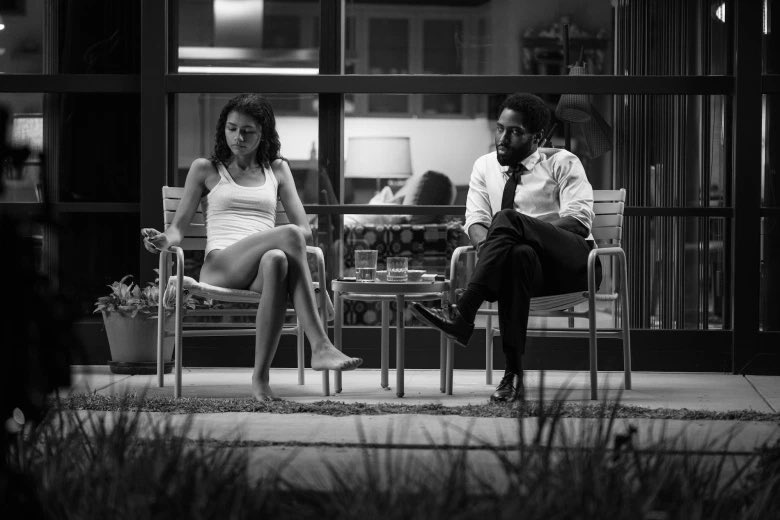
Malcolm & Marie come home from the premier of the film he wrote and directed to mixed feelings. Malcolm (John David Washington), on what he calls the best night of his life, is on top of the world, elated. He is the king tonight, who everyone is talking about. But Marie (Zendaya), on the other hand, is disappointed, for the opposite reason – no one is talking about her. Or, at least, her partner Malcolm didn’t. He forgot to include her in his “thank yous” at the premier, despite remembering hundreds of others, and she feels forgotten and disrespected. And from here, a one-hundred-and-six minute argument launches between the two, cataloguing a night where the truth comes out in their relationship.
The film, released on Netflix, has its ups and downs. The writer, director, producer Sam Levinson brings some of his brilliant directing vision and musicality from HBO’s Euphoria to play, with stunning shots throughout the film. One of the first is a minutes-long loop around the living room while Malcolm elates to Marie about the evening, following him from outside, or focusing on Zendaya smoking while he continues on his victory lap, all in a single shot that keeps us in the moment with them. Or later on, another still long shot while Malcolm runs around the house looking for his wallet and phone, the camera catching him while remaining still. And the final shot, where Marie’s empty bed is in the foreground, and she is in the background outside, as Malcolm searches for her. Not only the visuals, but the music used is strong too. It is a fundamental part of the film, where a new song being played often means the end of a scene and a breather, until the next confrontation. The opening scene with them playing James Brown was a delight to me.
Furthermore, the acting was brilliant. Zendaya rarely puts a foot wrong here and any other time, and John David Washington, who I admit I haven’t seen elsewhere, is strong too. You can dig into this with the strength of the long-takes in the film, as they pour themselves out to each other, not letting us go with a cut if they can help it. Zendaya has the best moment of the film at the end, where she pleads to John David’s Malcolm not to take her for granted any more in a powerful monologue that seemingly puts the conflict to bed, before they themselves fall asleep.
Despite these successes, though, there is more bad than good. Get ready.
To touch upon the actors again, while their performances are both strong, it is still too tough a challenge for them to carry the entire film on their own backs. The back-and-forth between the two – and only those two – became tiresome by the end of the film, where I was glad it was over, or else go about the same argument again.
The central point of the film, the argument, is also a point of issue. Usually, in a film based on an argument, you are meant to be able to connect with both sides of the issue, I find. They’re meant to both be half in the right, to both give the conflict steam and give the characters some redeeming qualities. Not here though, no. Instead, it is given to us as in John David’s Malcolm is bat-shit mad, bordering on abusive. He narcissistically goes through his various successes from the premier that night, every word good or bad said about him, and is completely oblivious to any of Marie’s potential issues, as if she should be fuelled solely by the light of his halo. Having Malcolm both successful and grating as a character is not easy to root for, so from the offing the viewer finds themselves rooting for Zendaya, as she dutifully makes him some mac and cheese for their late night without dinner. What makes it worse is the fact that with any sound of dissent or criticism, Malcolm shouts across the house that Marie is “unstable”, as if there has never been any issues before with a man dismissing his girlfriend’s issues as “bitches be crazy”.
And so, the rest of the film follows suit. We are encouraged to root for Zendaya’s Marie, but the film amounts to simply John David’s Malcolm hurling abuse at her for the rest of the night, save for a few moments of closeness as they catch their breath. That in itself leads to another issue – consequence. After the verbal sparring match we are forced to sit through, the film ends on the strong note of a heart-felt monologue of Marie, as described above. But, it is worth noting that Malcolm still doesn’t thank Marie. He says sorry, he tells her he loves her, and they go to sleep. He does say the words thank you, but it feels like it is because she turned off the bedside light, and not for any relationship-splitting argument they had that night. It is a really baffling omission, where the film says to you “this man is in the wrong, and his girlfriend puts him right. And he still doesn’t apologize for ever being wrong”. For ranting and abusing her the entire night, he is rewarded with a good night sleep.
And, let me tell you, the ranting is a real problem in the film. Like, if the conflict was fair and resolved well, that’d be one thing. But the incessant ranting that Malcolm displays is painful, to say the least. I praised the film for its long-takes and actors, but this is the other side of that coin. Malcolm, a man fuelled by selfishness and a need of validation, rants in the beginning long-take about a perceived racial issue with a female reporter at the premier (which itself is flawed, but I’ll let the guardian’s review of the film take the heavy lifting there: https://www.theguardian.com/film/2021/feb/05/malcolm-and-marie-sam-levinson-netflix-john-david-washington-zendaya), and again when that same reporter publishes a review of his film, which is reads at home. Now let me tell you, I almost turned off the film on the second instance there. I think it is the fault of Sam Levinson’s writing rather than John David Washington’s performance, but having Malcolm practically scream and shout about the review, and his reaction to it, for a solid five minutes or so, was exhausting. I wanted to turn off the film – imagine if it had been in a theatre?
What we’re left with at the end of this film is a visually stunning film pretending it is about anything meaningful. It is presented in black and white presumably to give the air of maturity, even though it tries to create a false equivalency between Malcolm’s inability to handle criticism with Marie’s former drug addiction struggles. There are more issues too, that I won’t touch upon.
Malcolm & Marie is best summed up by a Zendaya line near the beginning of the film, where she says “I promise you, nothing productive is going to be said tonight”.
 One Geo Under A Groove